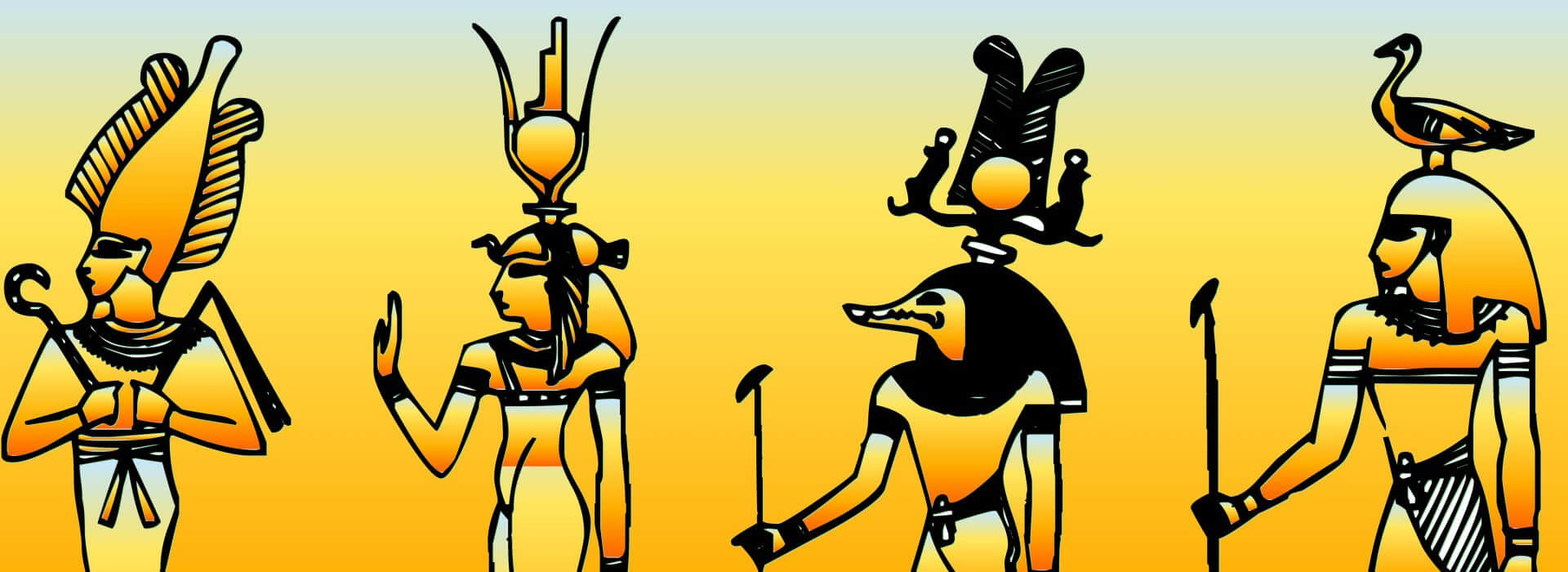
12 Well-Known Ancient Egyptian Gods and Goddesses
Ancient Egyptian religion was polytheistic and therefore there were thousands of ancient Egyptian gods and goddesses.
It is said that there are well over 2,000 gods and goddesses that were worshiped in ancient Egypt. These gods and goddesses were thought to have power over different aspects of nature and could intervene in different ways. However, not all ancient Egyptian gods had equal importance. Instead, only a few dozen ancient Egyptian gods and goddesses were believed to be most powerful while the rest of them were mostly spirits with certain powers. Besides, many gods with similar characteristics were worshipped in different Egyptian provinces with different names.
In ancient Egyptian religion, gods usually manifested themselves on the earth through animals. Knowing the basics about the ancient Egyptian gods and goddesses will add a lot more meaning when visiting the temples and other ancient Egyptian attractions. To prepare for your trip to Egypt or just for fun, we listed 12 Well-Known Ancient Egyptian Gods and Goddesses below:
#12 Sobek (the patron saint of kingship)
Famous for his crocodile head, Sobek was an ancient Egyptian god who guarded the Nile. At the same time, the Nile River was also seen as the creator of the world at first. He is closely connected with the military, and the so-called runic energy is also in his hands. In order to get the special favor of Sobek, the ancient Egyptians made crocodiles into mummies. Although Sobek was not the most powerful god, he was definitely the most revered god in ancient Egypt.
#11 Bastet (Goddess of Moon)
In the oldest myths, Bastet was originally a goddess of war with a lioness's head, but then slowly changed into the current cat’s head goddess, and during the period of Greek rule, it was further transformed into a god representing the moon.
Bastet, as the patron saint of Lower Egypt, was once seen as the guardian of the pharaohs, but her position was later replaced by Ra, so she and other lion goddesses (including Tefnut, Sekhmet, Hathor, etc.) were regarded as the Eye of Ra, a subordinate of the sun god. Therefore, many murals depict her fighting with the sun god Ra's archenemy, Apep, the serpent of chaos.
Her name is also related to the clay vase in which the balm was stored in ancient Egypt, so she is sometimes called the 'Guardian of Fragrance'. In addition to this, she is also the patron saint of the family, symbolizing the fight against disease and evil spirits.
The statues of Bastet are usually made of alabaster, sometimes holding a sistrum and aegis decorated with lion heads.
#10 Thoth (God of Wisdom)
Thoth was a god known for his calm and shrewdness. Thoth first appeared in the image of the moon god, and was later considered to be the designer of the universe and the mediator of good and evil. This god brought language and writing to the ancient Egyptians and gave them all knowledge. He has the appearance of an ibis-headed man, and is also described as a baboon holding a crescent moon.
#9 Geb (God of the Earth)
The ancient Egyptians believed he controlled earthquakes and tsunamis, and his tears filled the ocean. His image is of a man lying on the ground with green skin, which is said to represent the fertile Nile and all things that grow. Geb is responsible for the plants on both sides of the Nile. He also has a side business of imprisoning evil spirits so that they cannot enter heaven.
#8 Set (God of Desert and Storm)
The son of Geb, the earth god, Set is known for his tyranny. He was seen as protecting caravans in the desert from foreign guardian gods of Egypt. In fact, he killed his own brother, Osiris, and thus he was a longtime enemy of Osiris' son, Horus. Because of Seth's strong desire for rights and tyrannical nature, he committed crimes such as killing his brother and persecuting his nephew, which led to people's disgust.
Set is portrayed often as a fantastical mish-mash of a ton of different animals, which ancient Egyptians referred to as the “Seth animal.” The Seth animal would frequently have a human body, and a sloped, elongated head. As with other notable gods, he is shown holding the ankh in one hand, and a staff in another.
#7 Horus (God of the Sky and War)
Musakhan is a Jordanian dish of slices of bread, chicken, heaps of onions, fragrant spices like allspice and cinnamon, and lots of olive oil. The chicken is roasted and then baked together with a variety of spices including sumac and saffron which are regional spices and worth tasting while in Jordan. The dish is also comprised of onions and pine nuts which are toasted or fried and the entire mixture is served over bread which is baked in a clay oven.
#6 Hathor(Goddess of love and beauty)
Hathor is the goddess of love and beauty, the god of wealth, the god of dance, and the god of music in ancient Egyptian mythology. She cared for the common people, sympathized with the dead, and was also the protector of mothers and children. In various legends, she is the wife of Horus.
Worship of Hathor began as early as the 27th century BCE, and she was represented as a cow, a woman with a bull's head, or a woman with bull's ears. Legend has it that she once transformed into a fig tree and gave its fruit to the dead in hell.
#5 Isis (Goddess of Marriage and Nature)
The Egyptian goddess was in charge of marriage and life. In the story of Isis, she was the mother of Horus, and her adoration spread throughout the Greco-Roman world at the time. She is regarded as the ideal mother and wife, the patron saint of nature and magic. She was a friend to slaves, sinners, craftsmen, and the oppressed, and she heard the prayers of the rich, the maidens, the nobles, and rulers. She has always maintained her status as the most popular Egyptian goddess.
#4 Anubis (God of Death and Rebirth)
Anubis is the adopted son of Isis, and his duty is to protect the dead. In other words, Anubis decides whether a person can be reborn after death. If the deceased has a noble soul, Anubis will guide him to eternal life. For the Egyptians, the afterlife was very important to them, so Anubis was worshipped long ago. Anubis had the head of a jackal, a wild dog common in graveyards foraging for carrion. People prayed to him to bless the dead. He also helped Isis mummify her husband, Osiris, and gave Osiris the position of Hades.
#3 Osiris (Pluto, God of Agriculture)
Osiris has many identities in Egyptian mythology. He is the son of Geb, the brother of Set, the husband of Isis, the father of Horus, and the adoptive father of Anubis. This god is the central figure in Egyptian mythology. Anubis entrusted the position of Hades to the adoptive father, so he was also in charge of some afterlife affairs. He was killed by his brother Set before his death, his wife Isis collected his remains, and his son Horus and adopted son Anubis mummified him to help him regenerate. This life-and-death cycle made him deserve to be the Pluto. It is also said that Osiris guided the Egyptians from fishing and hunting civilization to agricultural civilization, teaching people to grow crops and wine, and become the giver of civilization.
#2 Ra (Sun God)
This god controlled the sun and became the most important god in ancient Egyptian mythology and was seen as the sun during the day. For more than a thousand years, Ra has been known as the supreme god of Egyptian religion. The sun god had absolute influence in the Fifth Dynasty of Egypt (2465-2323 BCE). Many of the sculptures found in the Valley of the Kings are based on Ra and the sun, and the pharaohs regarded Ra as their father.
Ra is first mentioned in the Pyramid Texts (c. 2400-2300 BCE), the oldest religious works in the world, which were inscribed on the sarcophagi and walls of tombs at Saqqara. In these, Ra gathers the soul of the king to himself and takes him to the paradise of the Field of Reeds in his golden barge. Worship of Ra was already well established at the time these texts – which are thought to derive from a much earlier oral tradition – were inscribed.
#1 Amun-Ra (God of Gods)
Amun-Ra was originally unknown to modern people, not a god in the traditional sense, he was associated with creation. This god of gods created himself and all things in the world around the 21st century BCE. He is shown in the world in the image of Amun-Ra, and is formed by the fusion of another sun god, Amun and Ra, and their beliefs are produced by the fusion of the sun god and other beliefs. His belief in the Greeks mutated into Zeus' intent. From this, we can also guess that Amun-Ra played a pivotal role in the process of life and death in ancient Egypt, and he will forever be the god of the gods in ancient Egypt.