10 Essential Places to Visit in Morocco
From the imperial cities of Rabat, Fez, and Marrakech to the imposing High Atlas Mountains and the vast Sahara, Morocco is country with unique history and culture.
With a history stretching back several millennia, Moroccan culture is a blend of all those that have occupied its past. The Berbers, Romans, Jews and Arabs, Spanish Moors, Portuguese, and French have all left their mark on Morocco, whether in its languages, cuisine, or its architecture.
Morocco's cities are some of the most exciting on the continent. Join the centuries-old trail of nomads and traders to their ancient hearts, from the winding medina maze of Fez to the carnivalesque street-theatre of the Djemaa El Fna in Marrakesh.
Morocco is also famous for its natural beauty, from the golden beaches of seaside towns like Essaouira and Asilah to the magnificent arid landscapes of the Sahara Desert. Here, the possibilities for adventure are endless: you can join in a camel-back trek through the Sahara, climb North Africa's highest peak or head to Dades Valley for a few nights in a traditional kasbah.
1. Marrakesh
Marrakech, the historical city of Morocco (Berber: Murakush, Arabic: مراكش), is the third largest city in the country and the political center of the southern region. It is famous for its red city. One of the most important ancient capitals in history, it is also the capital of the Marrakech-Tensift-Hauz economic zone from central to southwestern Morocco. It is located in the southern part of the border, 320 kilometers away from the capital Rabat in the north, and 50 kilometers away from the Great Atlas Mountains whose peaks are covered with snow all year round in the east. The historical sites and quiet gardens are well-known in the world and are known as the "Pearl of the South of Morocco".
Like many North African cities, Marrakech consists of an old fortified quarter (called medina) and an adjacent modern quarter (called Gueliz), with a total population of reached 1,070,000 people. Marrakech has Morocco's largest traditional market, and also has one of the busiest squares in Africa and the world. The Djemaa El Fna square is full of acrobats, storytellers, water sellers, dancers and musicians. At night, food stalls in the square open up, turning the square into an unprecedented lively open-air restaurant.
2. Fez
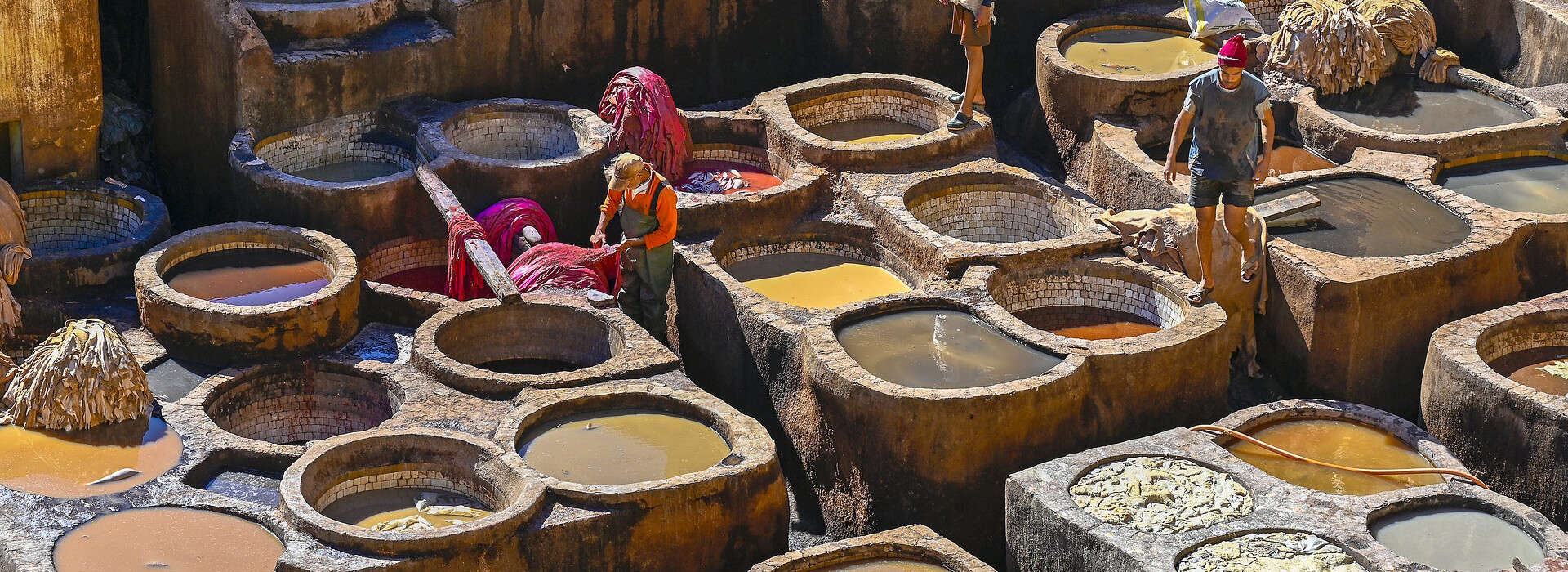
Fez was founded in 789 CE by the first sultan of the Idrisid dynasty. It served as Morocco's capital for more than 400 years and is still an important religious and cultural center. The old walled part of the city, known as Fes el-Bali, was founded in the 9th century and is recognized by UNESCO for the historical importance of its Idrisid dynasty architecture. It is best explored on foot and includes the Al Quaraouiyine mosque and its associated university, which is the oldest in the world (dating back to 859 CE). Other highlights include the Chaouwara Tanneries, the Merenid Tombs and the Mellah or Jewish Quarter.
3. Rabat
Located on the estuary of the river Bou Regreg , Rabat is Morocco's coastal capital since 1912 . Civilizations and dynasties from the Phoenicians to the Merenids have all claimed this place as their home. Here you can visit the Kasbah des Oudayas which is a majestic and splendid architecture embellished by the surrounding gardens in the Andalusian style. Not far from the walls, stand the imposing walls of the Chellah ; a necropolis from the time of the Merinids.
Or you can visit the Hassan Tower which is a minaret of an incomplete mosque. It was built in 1190 but construction stopped due to the death of Sultan Yacoub el-Mansour.
Like many Moroccan cities, Rabat has an old Medina. The Medina is the historic city center. It is full of narrow streets, shops, and restaurants. Place des Alaouites is the main square in the Medina. And be on the lookout for the Bab El Bhar gate!
4. Meknes
Meknes is a city in north-eastern Morocco founded in 711 CE by the Meknassa tribe, from which its name derives. It is only 130 kilometres from the capital Rabat.
Meknes is made up of the old part (medina) and the new part (ville nouvelle); two distinct centers less than three miles apart but harnessing quite different vibes. The medina holds the city’s historic sights and sought-after romantic favour, while in the ville nouvelle you'll find big houses, modern cars and branded takeaways.
There followings are the highlights of Meknes:
The El-Hedim Square: It is a bustling and picturesque square that is impossible to ignore when you visit Meknes. Just like the Jemaa el Fna in Marrakesh, it is usually at its busiest at sunset, when tourists mingle with the residents of the city who are trying to sell you all kinds of items, or just show you their skills as acrobats, fire eaters, storytellers, musicians or snake charmers.
Bab el-Mansour : Completed in 1732, the gate is impressive not only for its size but its original green and white zellij tiles, marble columns and inscriptions from the Quran along the top.
Volubilis : it is the ruins of a Roman city dating back to the third century BC, about 40 minutes’ drive from Meknes. The city marked the western edge of the Roman Empire, and would undoubtedly have felt like the edge of the world. Take a wander through the paved streets, zigzag among the buildings, spot olive presses and hunt for the detailed mosaics, which remain open to elements yet clear as day.
5. Casablanca
Casablanca is a port city and commercial hub in western Morocco, fronting the Atlantic Ocean. It is the largest city in Morocco and second in Africa after Cario. Famous from the 1940’s award winning movie, Casablanca is a city of love, drama, and passion. A city just like the Hollywood film, even though not a single scene was shot there.
The city’s French colonial legacy is seen in its downtown Mauresque architecture, a blend of Moorish style and European art deco. Standing partly over the water, the enormous Hassan II Mosque, completed in 1993, has a 210m minaret topped with lasers directed toward Mecca.
Make sure to visit the old medina, which is the place to go if you want to get a glimpse of what Casablanca was like before French rule.
6. Erfoud
Erfoud is an oasis town in the Sahara Desert, in the Drâa-Tafilalet region, eastern Morocco. Due to its proximity to Merzouga desert village in the Erg Chebbi Dunes, Erfoud is an ideal base for desert trip. It has developed tourist-related infrastructures such as hotels and restaurants.
The vast Sahara desert and region once laid under one of the world's oceans. As a result, archeologists have found sources of endless fossils; many concentrated in the area around the town of Erfoud. Visit the region's fossil museum, which prepares and sells fossils to collectors, universities, and museums worldwide.
Dotted all over Morocco are the remnants of Jewish life. Few Jews remain estimated around 3000 in the whole country. To learn more about Jewish history in Morocco, go to visit the shrine of Rabbi Shmuel Abu Hatziera which is located in the Jewish cemetery of Erfoud. The cemetery is well preserved and many of the tomb stones are readable.
7. Ouarzazate
Known as the 'door to the desert', Ouarzazate is a small town in the High Atlas Mountains of south-central Morocco. Ouarzazate is a Berber phrase meaning ‘without noise’ or ‘without confusion’ and it’s most famous for the location of the Kasbah-town of Aït Ben-Haddou, one of the world’s finest examples of North African pisé clay architecture dating back a thousand years.
The Citadel of Ait Ben-Haddou in the southern Moroccan town of Ouarzazate is a stunning example of North African pise clay architecture which dates back hundreds of years. It is a UNESCO World Heritage Site. The Ouarzazate area is a noted film-making location, with Morocco’s biggest studios inviting many international companies to work here.
8. Chefchaouen
Nicknamed the “blue pearl of Morocco.” The streets and most of the buildings in the old part of Chefchaouen are painted sky blue, giving the entire city a postcard-like quality that is stunning to see in person. Chefchaouen was founded in 1471 in the Rif mountains by Jews and Moors fleeing Spain. Here are the highlights of the city you should not miss:
Kasbah Museum: Kasbah means citadel or fortress, and this museum explores the city's history when it was once used as a base to protect the region.
Spanish Mosque: The Spanish Mosque isn't just an important place of worship in the city, but it also offers some of the best panoramic views of the Blue City. It's about a 45-minute hike to reach it from Chefchaouen's eastern gate, but the views are worth the endeavor (especially if you get there for sunrise or sunset).
The Rif Mountains that surround Chefchaouen are ideal for setting out on a day hike when the weather is nice. You can book a guided hike or just set out on your own right from the city. However, most of Morocco's marijuana farms are in the Rif Mountains, so don't stray too far from the path.
9. Tafraoute
Nestled in a valley among the Anti-Atlas Mountains in the south of Morocco, Tafraoute is one of the country’s most precious treasures. Tafraoute is the perfect base for climbers, hikers and those interested in exploring Berber culture in the surrounding hills. The region around Tafraoute is a great place to visit some spectacular agadirs—hilltop granaries perched at the top of sheer cliffs.
10. Tangier
Guarding the Strait of Gibraltar, Tangier has for centuries been Europes's gateway to Africa. Ruled through the centuries by waves of conquerors including Romans, Vandals, Byzantines, Arabs and Portuguese, the city is more than two and a half millennia old, making it one of North Africa's most ancient. The medina, kasbah, bazaars and souks are among the country's most vibrant, and the beaches are excellent.
One of the most beautiful places in Tangier is the so-called kasbah, the name given to the fortified complex situated on one of the city’s hills.