Top 10 Things to do in Marrakech
The name of Marrakech is from a Berber (Amazigh) word which means "Land of God". It is situated at the foot of the High Atlas, the highest mountainous barrier in North Africa. In its southern borders it to the south, and the Atlantic Ocean to the west. Stretching over 700 km, the High Atlas chain features a series of peaks of which a dozen attain 4,000 metres.
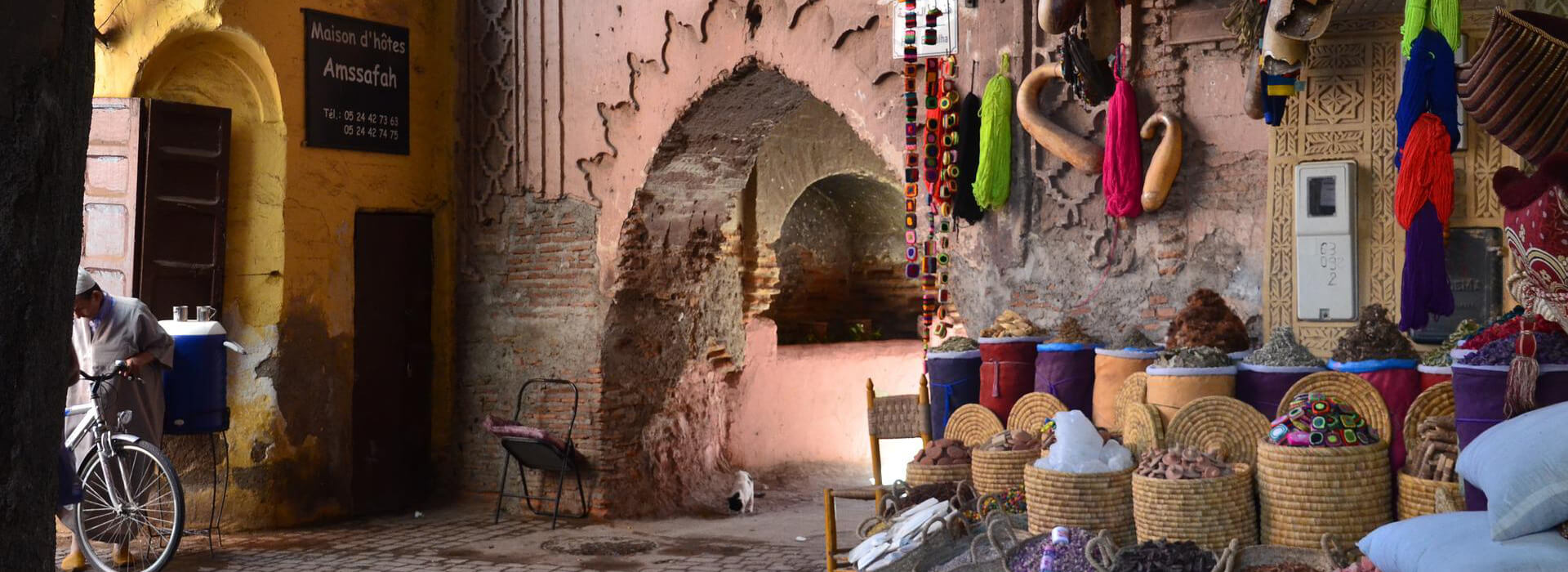
Marrakesh is famous for its colorful souks, Moorish architecture, intimate gardens and boutique hotels. You can either pend your days exploring the quiet courtyards and snaking alleyways of the historic Medina, walking through the serene Jardin Majorelle or taking in the beauty of the city’s mosques before ending the evening at a one-of-a-kind riad. “Riad” means “garden” in Arabic and only the finest of the medina houses with sumptuous central courtyards were worthy of the name.
1. Medina of Marrakesh
The Medina is an old part of Marrakesh that is walled, has narrow streets, and a collection of mosques, palaces, and fountains. In modern Arabic, “medina” translates to city or town. The Medina of Marrakesh became a UNESCO World Heritage Site in 1985. The name medina derives from the Prophet Mohammed, who founded the first Islamic community in a city named Medina. The medina started as a market place near a military stronghold at a desert oasis end 11th century developed into a walled city with a maze of alleys and backstreets, specialized souks and craft workplaces, resident quarters of rich and poor, mosques and palaces. The entire city is enclosed by gates and ramparts that cover 16 kilometers in length.
You should be careful of the scams at the entrance of media, the common scam is someone telling you they work at your hotel and they can show you around. At the end of the trip he will make it clear that he wishes to be suitably paid for his guidance.
2. Jemaa El Fna
The Jemaa el-Fna is Marrakech’s main square and the most important part of the medina.
During the day, the square is a massive open market with a particular fascination with selling orange juice. But as the sun sets and darkness descends it is transformed into a mix of Berber and Arab fantasy. Jemaa el Fna takes on an exotic ambience. Food stalls are in full swing and smoke from grills fill the air. Tables are set up and Jemaa el Fna becomes a makeshift dining space for thousands of hungry locals and tourists alike. It’s a stunning scene. Backed by the Koutobia Mosque and surrounding buildings, the square is illuminated with atmospheric lanterns, providing texture to the hundreds of stalls below.
Just a word of warning: you’ll find animal abuses here, monkeys in chains just for enjoying the tourists making a picture, snakes chucked on the ground, horses and donkeys forced to carry people on chariots.
3. Bahia Palace
Bahia Palace was built in the 1860s by Si Moussa, the powerful Grand Vizier of Sultan Hassan I of Morocco. And it was expanded by his son Ahmed ben Moussa (also known as Ba Ahmed) who served as Grand Vizier and as regent of Morocco during the reign of the child Sultan Abd al-Aziz.
The original furnitures were looted in 1900. But this lack of furnishings doesn’t detract from the splendor of the palace. Spread over 20 acres with gardens, courtyards and 150 rooms (only some of which are accessible to the public), the palace impresses thanks to its magnificent decorations, among the finest examples of Andalusian and Moorish architecture in Morocco.
The rooms for wives and concubines have carved-cedar ceilings; salons are lined by stained-glass windows; reception halls dazzle with their zellige tile mosaics in geometric patterns and delicate stuccoworks. The palace harem is decorated with woven-silk panels and more stained-glass windows, while the huge Grand Courtyard is a sight to see with its marble-tiled surface stretching out between the carved wooden galleries. Under the later French protectorate the palace was restored and was home to the French Resident General.
4. El Badi Palace
The palace was built in 1578 . The enormous royal residence took approximately 25 years to construct. The palace is believed to have contained more than 350 opulent rooms, in addition to a large pool, sweeping courtyard, and several gardens. Other palace features included summer pavilions, dungeons, and stables.
Master craftsmen and artisans from around the globe were employed to create marvellous designs, with the El Badi once showcasing some of the greatest decorative elements from the Saadi era. Each room was lavishly adorned with beautiful, and expensive, touches of luxury.
A civil war broke out in Morocco in early 1600s and palace started to fall into decay during that time . The palace is now a sandstone shell. The pool is often empty.
Nevertheless, El Badi Palace is still worth visiting. You can still feel the grandeur of the palace’s past in the courtyard, where four sunken orange orchards flank the central pool and ruins spread out in all directions.
5. Koutoubia Mosque
Largest in Marrakesh; made of red stone and brick; Featuring intricate tile work, salmon-hued walls, expansive archways and an impressive 77-metre-high (253 ft) minaret (or tower), this 12th-century Moorish mosque has served as the model for several other notable religious sites, including the Hassan Tower in Rabat, Morocco, and La Giralda in Seville, Spain.
A large part of its walls, built in brick and large sandstone blocks, are decorated with fine filigree in stone and tiles, particularly on the inside.
The mosque has a T-shaped floor plan with 90 x 60 m rectangles and 13 m high walls. The interior is divided into 17 naves, with wooden ceilings supported by columns and pointed arches that are reminiscent of buildings from the same period in Spain, such as the synagogue of Santa María la Blanca in Toledo.
Please notice that entry is restricted to people of the Muslim faith. Non-believers can walk around the temple on the outside and admire its imposing walls and buttresses.
6. Majorelle Garden
Once owned by Jacques Majorelle, then Yves Saint Laurent; the garden is famed for its floral and colorful designs.
Located just northwest of the city’s medieval medina walls, the garden is a 2.5-acre oasis in the heart of the Moroccan imperial city. It’s also an important tourist attraction in its own right, welcoming more than 700,000 visitors every year.
The plot that is now renowned as one of the world’s most beautiful botanical gardens was purchased by French Orientalist artist Jacques Majorelle in 1923.
Discover sculpted flower beds and labyrinthine alleyways, towering groves of bamboo and coconut palms, cacti in fantastical shapes, and tumbling screens of purple bougainvillea. Water features take center stage throughout the garden, with channels, pools, and musical fountains all employed to create distinct spaces for relaxation and reflection.
7. Visit a hammam
Hammam which means 'hot water' in Arabic has its origins in the Roman baths. It is just another word for bath house. Like most bath houses around the world, in a Moroccan bath, you can expect to be steamed, soaked, scrubbed, and come out sparkly clean. For Moroccans, a hammam bath is also a social event.
Public baths are believed to have originated during Roman times. With the introduction and spread of Islam, bathing rituals took on a spiritual aspect. The importance of purifying one’s body before prayers and devoting time to quiet reflection, combined with practical realities like a lack of hot water in private homes, helped hammam flourish.
8. Visit Saadian Tombs
Saadian Tombs are a series of sepulchers and mausoleums in Marrakech that house the remains of important figures from the Saadi Dynasty, which ruled Morocco from 1549 to 1659. Shortly after the fall of the dynasty, the tombs were sealed off and hidden, only to be rediscovered in 1917.
The royal necropolis on which the Saadian Tombs were built was likely in use since the beginning of the 14th century. But it was during the reign of Ahmed el-Mansour, the Saadi Sultan from 1578 to 1603, that the tombs reached a far more prominent and lavish status.
The complex is breathtaking in its design, with soaring domed ceilings, intricate wood carvings, and imported marble statuary. Throughout the tombs, colorful tile mosaics and lattice-like plasterwork stand as a testament to the skill of 16th century artisans. There are two main mausoleums, together containing 66 tombs. The rose-filled garden provides space for the graves of over 100 members of the royal household—including trusted advisors, soldiers, and servants. These lesser graves are decorated with carved Islamic inscriptions.
9. Make Your Heart Soar on a Hot Air Balloon Ride
Enjoy bird’s-eye views of Morocco’s deserts and the foothills of the Atlas Mountains on a sunrise hot-air balloon ride from Marrakech. Hot air balloon trips are popular in Marrakech and a number of companies offer them. However, their packages vary considerably. You should choose a provider specializing in balloon tours, having conducted these in Marrakech for many years.
10. Checking out the Atlas Mountains
One of Marrakech's key attractions is that it lies within easy reach of the Atlas Mountains, meaning that cool retreats from the heat and dust of the city are close at hand. In winter, it is even possible to ski in High Atlas Mountains. The traditional home of the Atlas Berbers, the mountains is also full of culture and history.
The town of Lalla Takerkoust, 43 kilometers (27 miles) to the southwest, is chiefly known for its nearby dam and lake and is a great place for quad biking, camel riding or simply admiring view of the peaks.
The valley of Ourika in the Atlas foothills, some 60 kilometers to the south of Marrakech, is a popular escape to see Berber villages surrounded by waterfalls and rivers.
If you don’t mind 4 hours’ drive, you can do a day trip to Aït Benhaddou , one of the most famous fortified villages(or ksar/Kasbah) in the Atlas Mountains . It is a UNESCO World Heritage site that has been occupied since the 11th century. It's located on the historic caravan route between Marrakesh and the Sahara Desert and is made entirely out of compressed earth, clay, and wood. Its impressive architecture has served as the backdrop for many films and series including "Gladiator" and "Game of Thrones."